
Once a Gamer, Always a Gamer: How to Bring the Fun Back to Rushed Playthroughs

Quick Overview
- The real problem isn’t time or age it’s the habits you’ve absorbed from the internet’s idea of how games “should” be played: completion percentages, backlogs, optimal-build guides.
- Drop the backlog. You don’t owe any game a completion. Quit guilt-free if a game feels like a chore after a few hours.
- Go in blind. Ditch the second-screen guides and spoilers discovery was always the point.
- Slow down inside the game. Read cutscenes, walk instead of sprint, play inefficiently on purpose.
- Run a main game + a side game to cure decision fatigue without scattering your focus.
- Make gaming the reward, not stolen time do the chores first, then play with a clear head.
- Redefine “finishing” as immersion, not the credits screen.
There a Specific Kind of Tired Only Gamers Know
You start a game that you really want to play and after 20 minutes, you begin to wonder how much time the main story takes to beat. You are running through NPCs while you are talking. You have another monitor open with a wiki. Along comes the feeling of escape that suddenly became a second job, a job you had to do but with a backlog, with deadlines, a feeling of being behind.
If that’s a little too close, you are not broken and you’re not too old to enjoy the hobby. You’ve developed some subtle bad habits that are slowly killing the enjoyment from it. The great news is that those behaviors are changeable and you don’t need to find more free time to make them change. One must have another relationship to the time that’s already there.
Why Playing Got so Fast in the First Place
It’s worth understanding what actually happened, because “I’m just busy now” is only half the story. Most of us didn’t lose interest in games we absorbed the internet’s idea of how games should be consumed.
Completion percentages, achievement lists, "how long to beat" databases, optimal build guides, tier lists for single-player games that have no competitive scene whatsoever. None of that existed when most longtime gamers first fell in love with the medium. You played a game until it was done or until something else caught your eye, and that was the whole arrangement. Now there's an entire scaffolding of metrics telling you whether you're playing correctly, and your brain trained by everything else in modern life treats those metrics as goals.Add a backlog of forty unplayed titles you bought on sale, and gaming stops being a choice you make for pleasure. It becomes a queue you’re behind on. That’s the actual problem. Not your attention span, not your age, not “games these days.” It’s the queue.
Drop The Backlog Before it Drops You
So start there. That mental “to-play” list is doing nothing for you except generating low-grade guilt every time you sit down. You didn’t sign a contract with your Steam library. Those games will not expire, and no one is keeping score.
Try this reframe: you don’t owe any game a completion. You owe yourself an enjoyable evening. Those are completely different commitments, and only one of them is actually yours to honor.
This also means giving yourself full permission to drop a game without guilt. If you’re three or four hours in and it feels like a chore, that feeling is information, not failure. Put it down. Uninstall it if you want. A game you abandon at hour four cost you one evening. A game you grind through resentfully for forty hours cost you forty. Quitting is often the financially and emotionally smarter move, and treating it as a personal shortcoming is exactly backwards.
Go in Blind And Stay There
Here’s the habit that does the most damage for how harmless it looks: the second-screen guide.
Looking up the optimal build, the fastest route, the missable collectibles, the “don’t waste your points on X” video each individual lookup feels efficient. Collectively they convert your playthrough into data entry. You’re no longer discovering a game; you’re executing someone else’s spreadsheet of it. And discovery was the entire point. The magic of an older playthrough wasn’t that you played it well. It’s that you didn’t know what was coming.
So go in blind, and hold that line even when it itches:
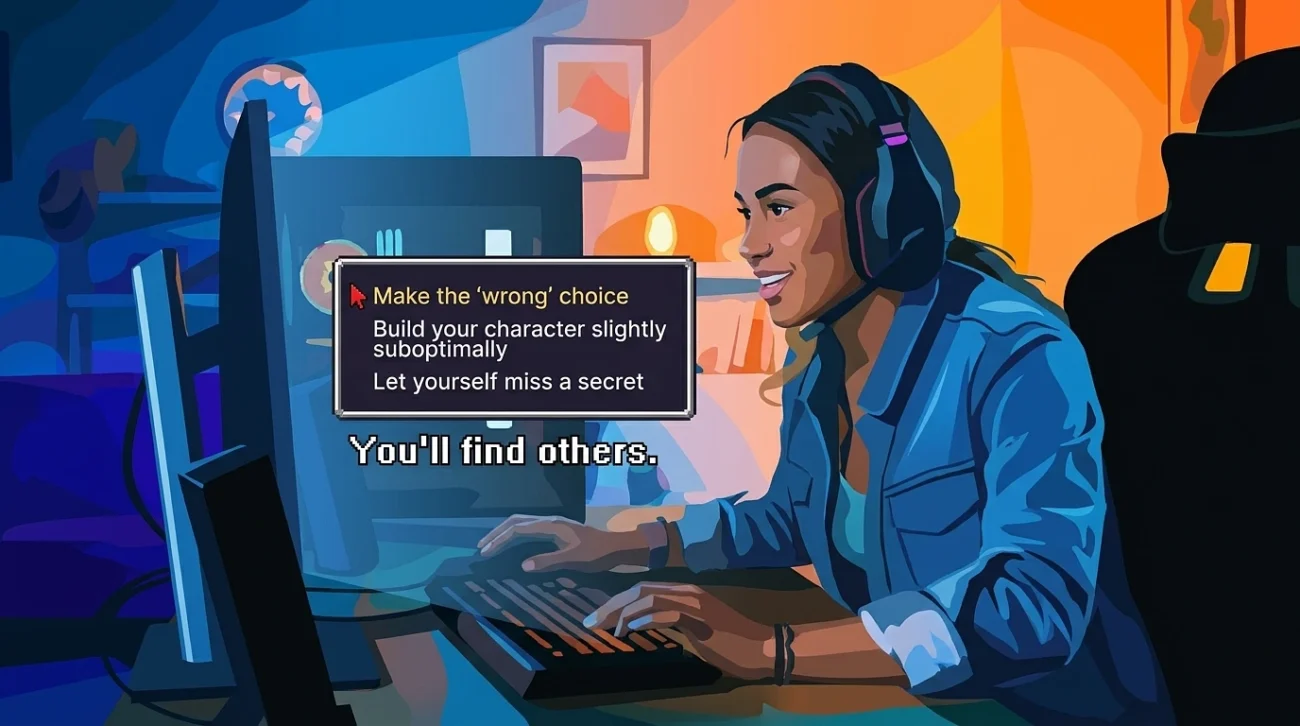
- Make the “wrong” choice in the dialogue tree.
- Build your character slightly suboptimally it won’t ruin anything.
- Let yourself miss a secret. You’ll find others.
A messy, personal, slightly-broken playthrough is something you'll actually remember, because it was yours. A perfectly optimized one is indistinguishable from everyone else's who watched the same video.
This is reinforced through the usage of offline play, if possible. It’s not a matter of disconnecting for disconnecting’s sake, it’s when you’re not connected and you’re not under the pressure of keeping up with a community, comparing your progress, or whether you’re “doing it right”. There is no right. It’s only the game and you.
Slow Down Inside the Game Itself
Once the external pressure is gone, you can fix the pace of play itself, and this is where the fun actually lives.
- Stop skipping cutscenes. The player rushes through and skips past all the dialogue, character development and world-building that took years to write, and questions the following objective marker, “Why was the story thin? Incorporate pauses, let discussions breathe as written.
- Walk instead of sprinting everywhere. Take the path that isn’t the glowing line on your minimap. Play inefficiently on purpose poke at mechanics, wander into the area you’re “not supposed to” visit yet, try the strategy that probably won’t work. Developers built entire corners of these worlds that optimized players never see. Going slightly off-script is how you find them.
And if you’re grinding difficulty settings purely to one-shot enemies and farm XP faster, ask what that’s actually buying you. Speed-leveling toward boredom is still boredom; you just get there quicker. There’s no shame in lowering the difficulty either. If combat is friction between you and a world you want to explore, turn the friction down and enjoy the world.
Run a Main Game and a Side Game
A practical structure that genuinely works: keep one main game and one side game going at once.
Think of it as a main course and a dessert:
- The main is your dense, narrative-heavy investment the one you want to sink into properly.
- The side game is light, mechanical, low-stakes: something cozy or sandboxy you can dip into for twenty minutes without tracking a plot. Stardew Valley, Minecraft, PowerWash Simulator that genre of game with no fail state and no urgency.
This isn’t the same as juggling six games and feeling scattered. It’s a deliberate pairing of two. When the heavy game asks too much of you on a tired evening, you have a relaxing alternative that doesn’t pull you off your main story for good. It cures the decision fatigue that usually sends people spiraling through their whole library without committing to anything.
And if your burnout is specifically the kind of game you keep playing the third eighty-hour open-world RPG in a row switching genres entirely can reset your internal clock. A short arcade indie or a slow cozy title recalibrates what "normal pace" even feels like.
Make Gaming the Reward, Not the Guilt
A surprising amount of mid-game restlessness that itch that you should be doing something else comes from playing while chores quietly loom.
Flip the order. Do the productive thing first: cook the meal, do the workout, clear the small task that’s been nagging you. Then sit down to play with nothing hanging over you. The game becomes earned downtime instead of stolen time, and that single change removes most of the background anxiety that makes you rush.
The physical space matters more than people expect, too. A cluttered desk keeps your brain in work mode. Clearing it, even just a little, signals leisure you’re telling yourself this is the relaxed part of the day, not more work at the same messy station where the work happens.