
GTA 6 Is Four Months Out and This Is the Cheapest Path to a PC That Runs It

GTA 6 launches November 19, 2026 on PS5 and Xbox Series consoles, and here is the fact that shapes every dollar of this article: there is no PC version. Rockstar has not announced one, has not dated one, and has not published a single official PC requirement. So the cheapest path to a PC that runs GTA 6 starts with refusing to buy anything for a game that does not exist on the platform yet. What you can do, and what I am going to do here, is work out what the eventual port will demand, price the minimum hardware that clears that bar, and figure out which purchases make sense now versus which ones are just burning money four months before a console launch.
I have watched people spec $1,500 rigs “for GTA 6” all year. Most of that spending is premature, and some of it is aimed at the wrong parts entirely.
Start With the Timeline, Because It Changes Everything
Rockstar's own history sets the schedule. GTA 5 hit consoles in September 2013 and reached PC roughly 19 months later. Red Dead Redemption 2 took about 13 months. Apply that pattern to a November 19, 2026 console launch and the realistic PC window opens around late 2027 and runs into 2028.
That gap is the whole argument. A GPU bought today will be a year and a half old before GTA 6 can use it, in a market where prices are currently inflated by the AI hardware crunch and a next generation of cards is expected in 2027. Buying the finished PC right now means paying 2026 prices for 2028 performance requirements, which is the most expensive possible order of operations.
The cheap path buys in two stages: the parts that hold value now, the GPU last.
What the Port Will Actually Target
Nobody outside Rockstar knows the PC requirements, so I am not going to invent a spec sheet. What I can do is the same math every port eventually obeys: the game is built to run on a PS5, so PS5 equivalent hardware is the floor.
That console runs an 8 core Zen 2 CPU and a GPU in the neighborhood of an RX 6700 with fast shared memory. Translate that to PC parts with normal overhead for Windows and unoptimized ports, and the realistic floor for a console quality experience looks like this:
- An 8 core CPU from any recent generation, or a strong 6 core from the current ones.
- A GPU at or above RX 6700 class raster performance.
- 16 GB of VRAM as the safe target, because Rockstar ports lean hard on texture streaming and every recent big port has punished 8 GB cards at settings above medium.
- 32 GB of system RAM and a 1 TB NVMe drive, since the game reportedly weighs in well past 100 GB on console.
The VRAM point deserves its own emphasis. The single most predictable way to buy the wrong card for GTA 6 is grabbing an 8 GB GPU because it benchmarks fine in 2026 games. It probably will not be fine in a 2028 Rockstar port, and 8 GB cards are the ones being quietly squeezed out of the market already. We covered what running out of video memory actually looks like in our out of video memory crash guide, and the pattern there repeats with every demanding release: cards that were “enough” at launch reviews start throwing that error two years later.
The Build That Clears the Bar
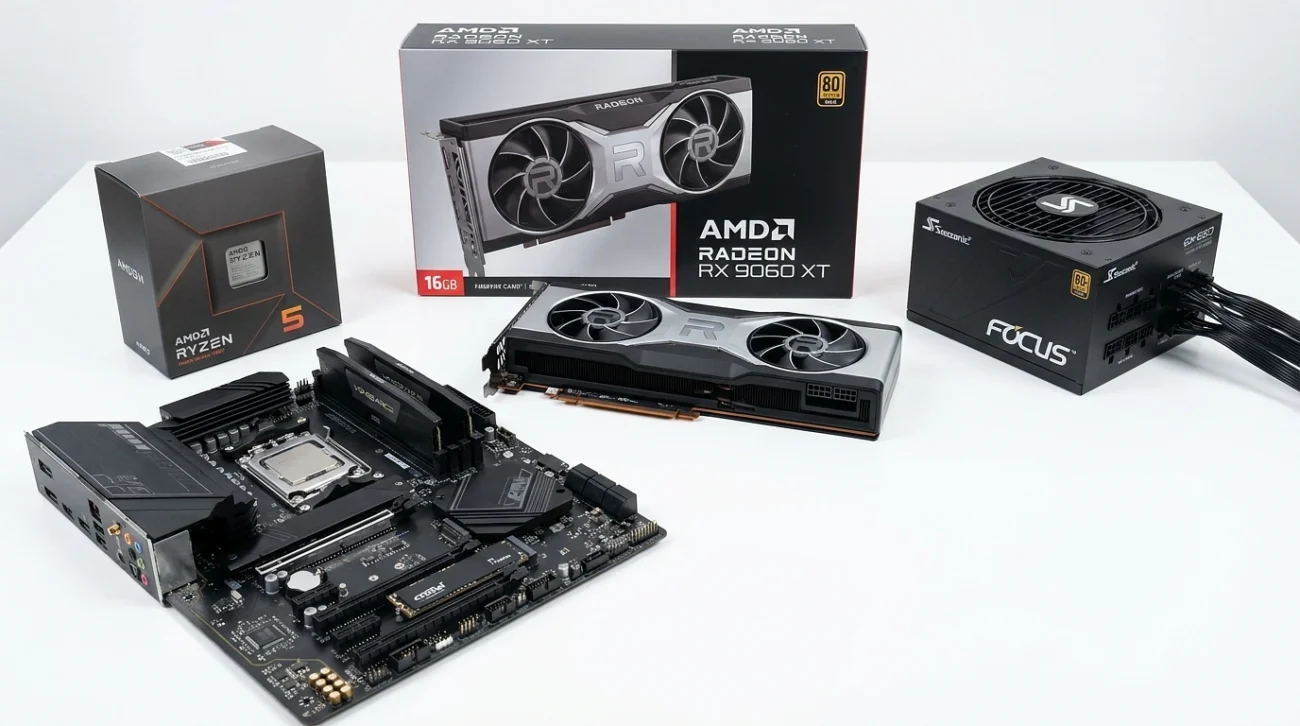
Here is the cheapest configuration I would actually put my name on, priced at current US street rates:
- CPU: Ryzen 5 7500F or equivalent current 6 core, around $150.
- Motherboard and 32 GB DDR5: around $220 combined if you shop the bundle deals.
- 1 TB NVMe SSD: around $70.
- Case, 650 W power supply, cooler: around $130 total.
- GPU: RX 9060 XT 16 GB, currently floating between $350 and $460 depending on the week and the retailer, per Tom’s Hardware’s ongoing GPU price tracking.
That lands the full tower between $920 and $1,030 at today’s prices, and it comfortably exceeds the PS5 floor with VRAM headroom for whatever the port demands. The Arc B580 at roughly $250 to $290 is the tempting cut, and TechSpot’s current GPU rankings back it as genuinely the best value card on the shelf right now, but 12 GB is a gamble on a game we cannot benchmark yet. I would not make that bet to save a hundred dollars on a purchase this far ahead.
The Two Stage Version Is Cheaper
Buy everything except the GPU now, roughly $570 of platform, and run integrated graphics or a placeholder card until Rockstar actually announces PC requirements. Then buy the GPU against real published specs instead of my educated guessing. By late 2027 the 9060 XT will have dropped or been replaced, and the AI driven price inflation has at least a chance of easing. The two stage build almost certainly comes in under $900 total, and it eliminates the only real risk in the parts list, which is the graphics card.
The platform parts carry almost no such risk. CPUs, RAM, and storage requirements are boringly predictable, and those components have been climbing in price, not falling, so early is fine there. A platform bought now also earns its keep before GTA 6 ever arrives, and if you plan to stream your playthrough, our guide on optimising a gaming PC for streaming is worth a read while you wait, since the 8 core CPU recommendation above is exactly what encoding overhead calls for.
The Answer Some of You Will Not Like
Run the numbers without sentiment and the cheapest machine that plays GTA 6 in 2026 is a $499 PS5, or the digital edition when it goes on sale below that. It plays the game on day one. The cheapest capable PC costs roughly double and plays it in a year and a half, maybe two.
I say that as someone who will absolutely wait for the PC version, because Rockstar PC ports bring the uncapped framerates, ultrawide support, and mods that make these games live for a decade. Waiting is a defensible choice and 39 percent of PC Gamer’s polled readers said they are making it. It is just not the cheap choice, and pretending otherwise is how people end up owning both a rushed PC build and a console anyway.
One practical note for whichever route you take. GTA 6 is a twin stick, aim sensitive game, and Rockstar’s aim feel has always been picky about stick condition. If the pad you plan to use is a few years old, measure its drift and deadzone behavior before launch week rather than during it. A worn stick you could ignore in a survival game becomes very noticeable the first time you try to hold a bead on someone from a moving car.