
Is the Ryzen 9850X3D Upgrade Worth It for RTX 5090 Story Games?

Overview
Pairing the Nvidia RTX 5090 with the absolute best processor seems like a no-brainer if you want a zero-compromise gaming rig. With AMD introducing the Ryzen 7 9850X3D alongside the existing 9800X3D, builders face a fresh dilemma. The 9850X3D serves up a 400 MHz factory clock bump (pushing it to 5.6 GHz), but when it comes to massive, visually heavy story games at high resolutions, the real-world performance gain flatlines at around 3% to 4%.
For narrative-driven AAA gaming, swapping a 9800X3D for a 9850X3D yields a difference you won’t even notice without a benchmark counter running.
The Core Dilemma: CPU vs. GPU Bottlenecks
When you back a monster GPU like the RTX 5090 with a top-tier AM5 chip, your system's performance ceiling shifts entirely based on what you are playing.
- The GPU Does the Heavy Lifting: Cinematic, open-world titles like Cyberpunk 2077 or Star Wars Outlaws are incredibly graphics-heavy. When you crank the resolution to 1440p or 4K and enable path tracing, virtually 100% of the workload lands squarely on the RTX 5090.
- The CPU’s Real Job: Processors equipped with AMD’s 3D V-Cache don’t necessarily push peak frame rates into the stratosphere in graphics-bound scenarios. Instead, they act as a high-speed feeder system for the GPU, keeping your minimum frame rates stable and erasing micro-stutters.
- The Margin of Real-World Difference: While the 9850X3D hits a higher 5.6 GHz boost clock over the 9800X3D’s 5.2 GHz, this extra frequency mostly sits idle in AAA story games. Because the graphics card is working at its absolute limit, the faster CPU is simply left waiting for the GPU to finish rendering each frame.
Why the Upgrade Falls Short for Story Gamers
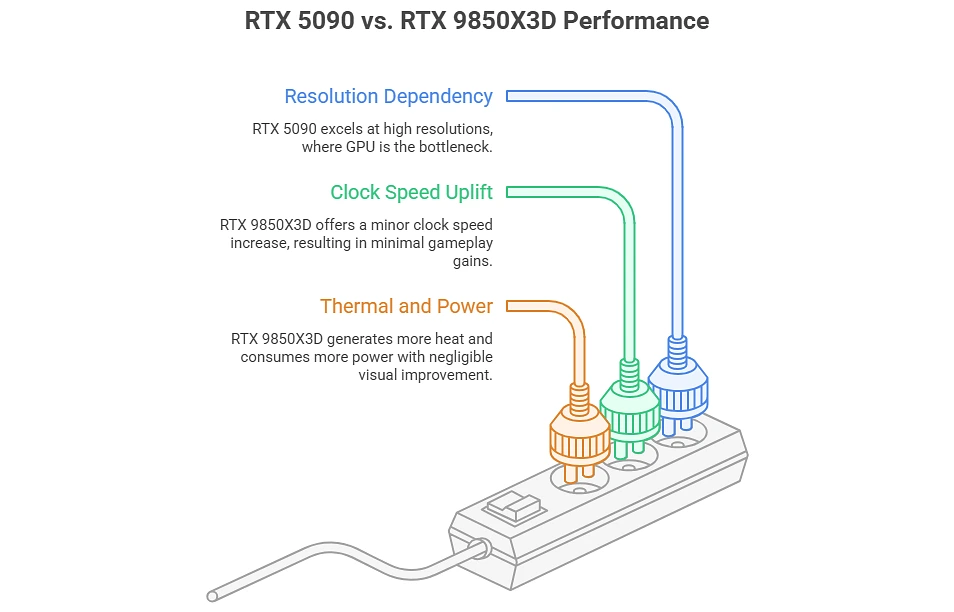
1. Hard Resolution Dependency
No one buys an RTX 5090 to play story games at 1080p. At 1440p ultra or native 4K, your system is strictly GPU-bound. A faster processor cannot unlock extra visual detail, richer textures, or higher ray-traced fidelity; that is entirely the graphics card’s domain.
2. Tiny Clock Speed Uplift
Under the hood, these two chips share the exact same DNA: the Zen 5 architecture, a 120W TDP baseline, and 96MB of stacked L3 cache. The 9850X3D is essentially a highly binned, factory-overclocked version of the 9800X3D. That 400 MHz difference looks clean on a spec sheet, but it only translates to a single-digit percentage bump in active gameplay.
3. Thermal and Power Realities
Pushing higher clock speeds on the same fundamental architecture means the 9850X3D draws a bit more power and generates more heat under full load. Dealing with extra thermal output and increased power draw makes little sense when the visible payoff on your monitor is virtually zero.
Practical Buying Advice
- If you already own a 9800X3D: Do not upgrade. Your current setup sits at the absolute pinnacle of gaming performance. Replacing it would be a waste of hardware and cash.
- If you are building a brand-new rig: If the price gap between the two chips is minor (under $30), buying the 9850X3D gives you the fastest overall gaming chip on paper. However, if the premium is steep, save your money. Allocate those funds toward faster low-latency RAM, an extra terabyte of NVMe storage, or better cooling.
Real-World Example: Cyberpunk 2077 (Phantom Liberty)
Let’s put the data into perspective with a highly demanding, path-traced open world that uses complex crowd AI and heavy physics.
If you run an RTX 5090 paired with a Ryzen 7 9800X3D at 1440p with maxed-out settings, your system might average roughly 120 frames per second.
If you pull that chip out and drop in a Ryzen 7 9850X3D, your average frame rate will lift to about 124 frames per second.
An extra 4 frames per second represents a mere 3.3% performance jump. The human eye cannot detect a variance that small during fast-paced movement or cutscenes. Instead of paying a massive premium for a 4-frame difference, that cash is far better spent upgrading to a premium 4K high-refresh-rate monitor to actually let your RTX 5090 stretch its wings.