
Where “No-Logs” Can’t Be True: The 2026 Country Guide to VPN Data Retention Laws

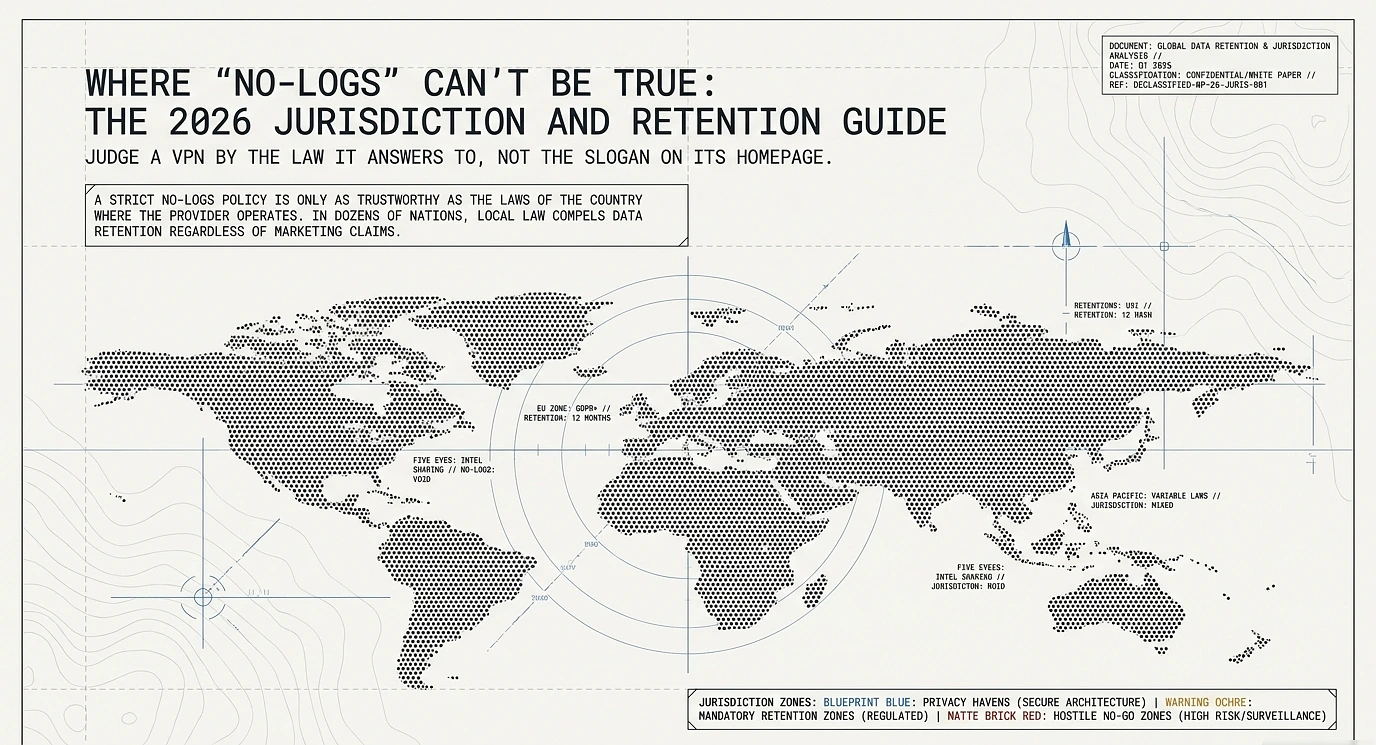
A VPN’s promise to keep no records is only ever as trustworthy as the laws of the country it operates under. Many providers advertise a strict no-logs policy, yet in dozens of nations the law compels them to retain user data regardless of what the marketing says. This guide sets out the 2026 position jurisdiction by jurisdiction the privacy havens where no-logs can hold up, the countries whose retention mandates render it impossible, and the places where the real concern is using a VPN at all. It then lays out the practical tests that separate a credible claim from an empty one, namely the provider’s jurisdiction, its server architecture, and its record of independent audits. The principle beneath it all is straightforward judge a VPN by the law it answers to, not the slogan on its homepage.
The Passport Matters More Than The Privacy Policy

The single most important fact about a VPN isn’t a feature in the app. It’s where the company is legally based and where its servers physically sit. That’s the jurisdiction, and it decides what a government can force the provider to hand over.
The trend isn’t moving in your favor. As of 2026, at least 47 countries have active data retention mandates that can reach VPN providers, up from around 23 in 2020, with more drafting laws right now. A no-logs policy is a promise. A retention law is an order. When the two collide, the order wins, and the provider either complies, leaves the country, or shuts down.
Where The Law Lets A VPN Keep Nothing
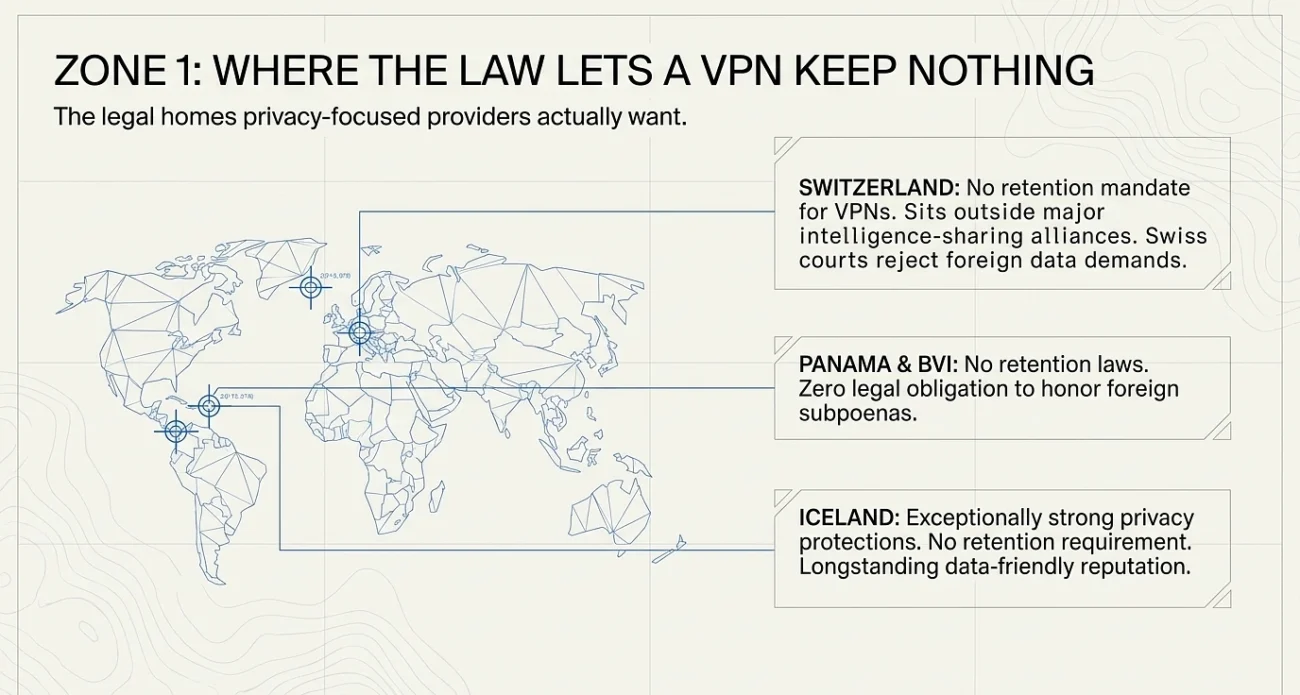
A short list of countries have no mandatory data retention for VPN operators, which is exactly what makes a no-logs claim credible there. These are the homes privacy-focused providers actually want:
In these places, a provider that says it keeps nothing can be telling the literal truth, because no law forces it to keep anything in the first place.
Where The Government Writes The Logs For Them
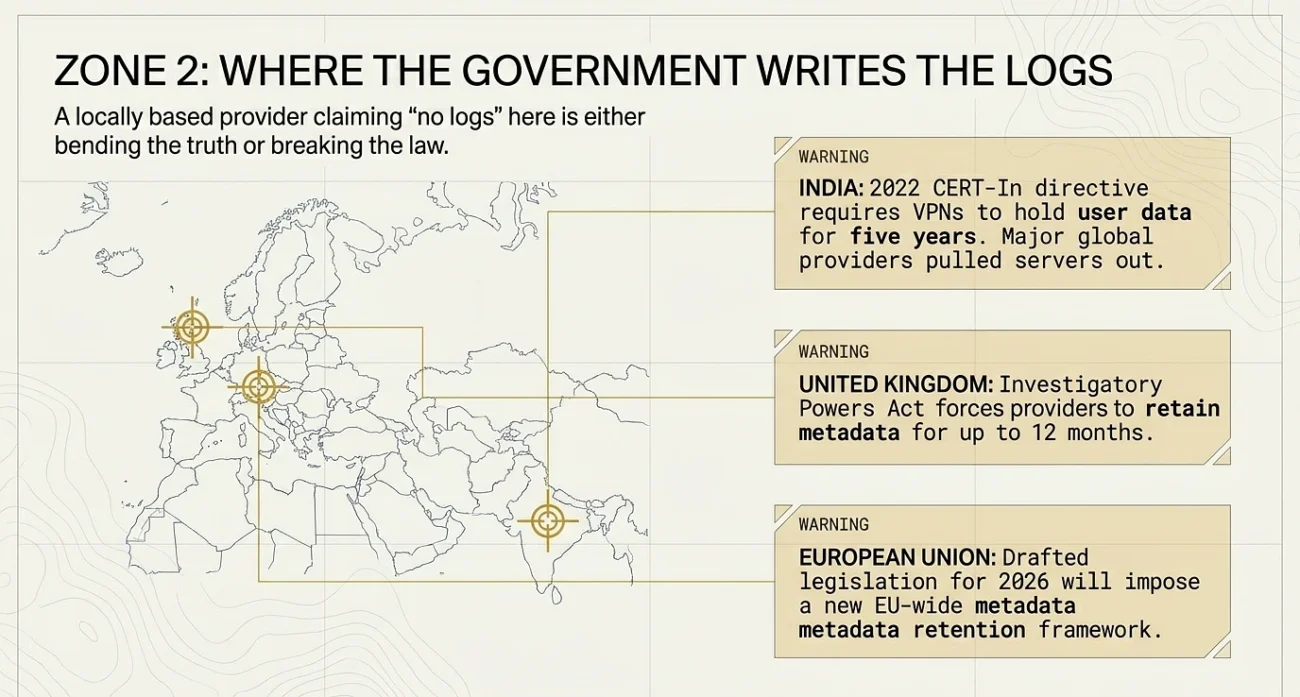
This is the half of the map the marketing never mentions. Here the law requires retention, so a locally based provider claiming "no logs" is either bending the truth or about to break the law:
- India. A 2022 CERT-In directive requires VPN providers to hold user data, including names and activity, for five years. The response was telling: rather than comply, the major global providers pulled their servers out of the country.
- The United Kingdom. The Investigatory Powers Act lets authorities require service providers to retain communications metadata for up to twelve months and cooperate with lawful requests.
- The European Union. It’s a patchwork today, but the European Commission is pushing a new EU-wide metadata retention framework, with draft legislation expected in 2026. Where it lands will redraw this section for a lot of providers.
A provider with servers and a legal home in one of these countries can’t honestly promise to keep nothing. The law already decided.
The No-Go Zones
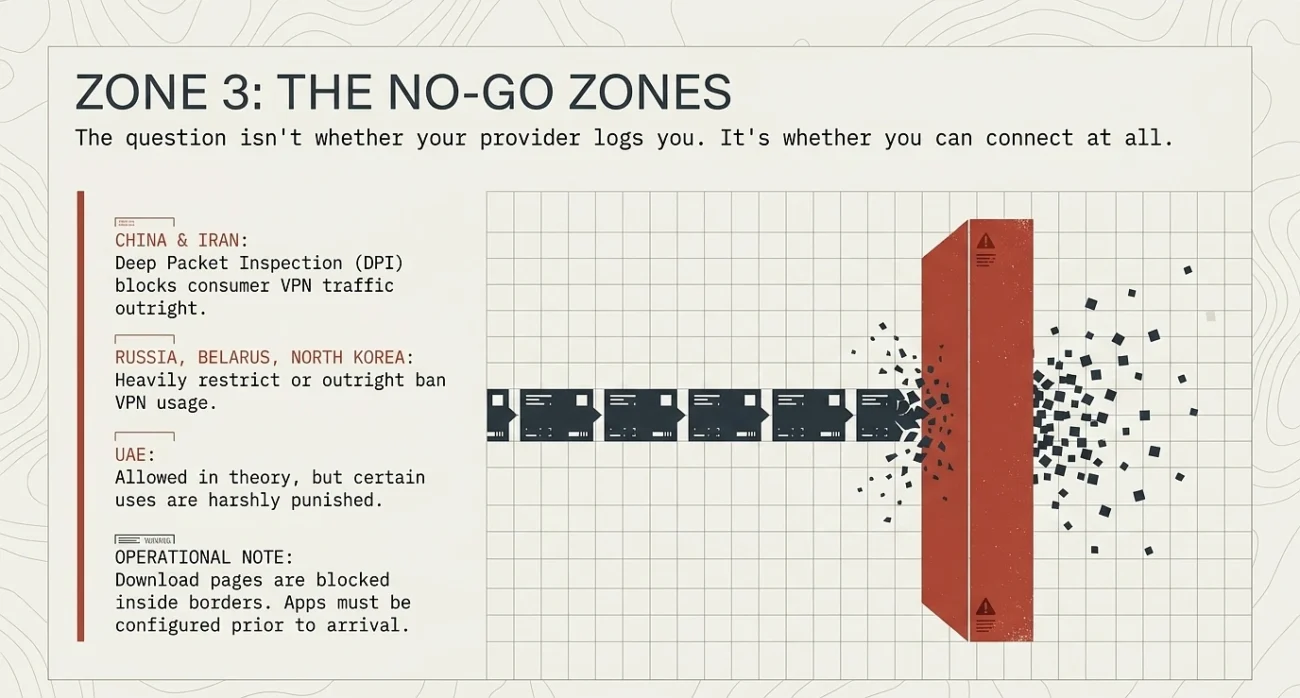
A separate tier doesn't just force logging, it goes after the VPN itself. Here the question isn't whether your provider logs you. It's whether you can connect at all without consequences:
- China and Iran run the most aggressive systems, using deep packet inspection to block most consumer VPN traffic outright.
- Russia, Belarus, Turkmenistan, and North Korea restrict or ban VPN use to varying degrees.
- The UAE and a few others allow VPNs in theory but punish certain uses, sometimes harshly.
Traveling to any of these, the rules around using a VPN matter more than any logging policy, and you’ll want the app set up before you arrive, since the download pages are usually blocked once you’re inside.
How The Good Providers Dodge The Bad Laws
The reputable providers know all of this, and the trustworthy ones build around it instead of pretending it doesn't apply. A few moves separate them from the rest:
- They base themselves in the haven countries, so no retention law can reach them to begin with.
- They run RAM-only servers. Nothing is written to a disk, so a seized machine has nothing on it, and the moment power is cut, any data is gone. This is now standard at the major names.
- They leave hostile jurisdictions rather than comply, the way several did with India.
- They pay for independent audits, so a no-logs claim is checked by an outside firm instead of just asserted.
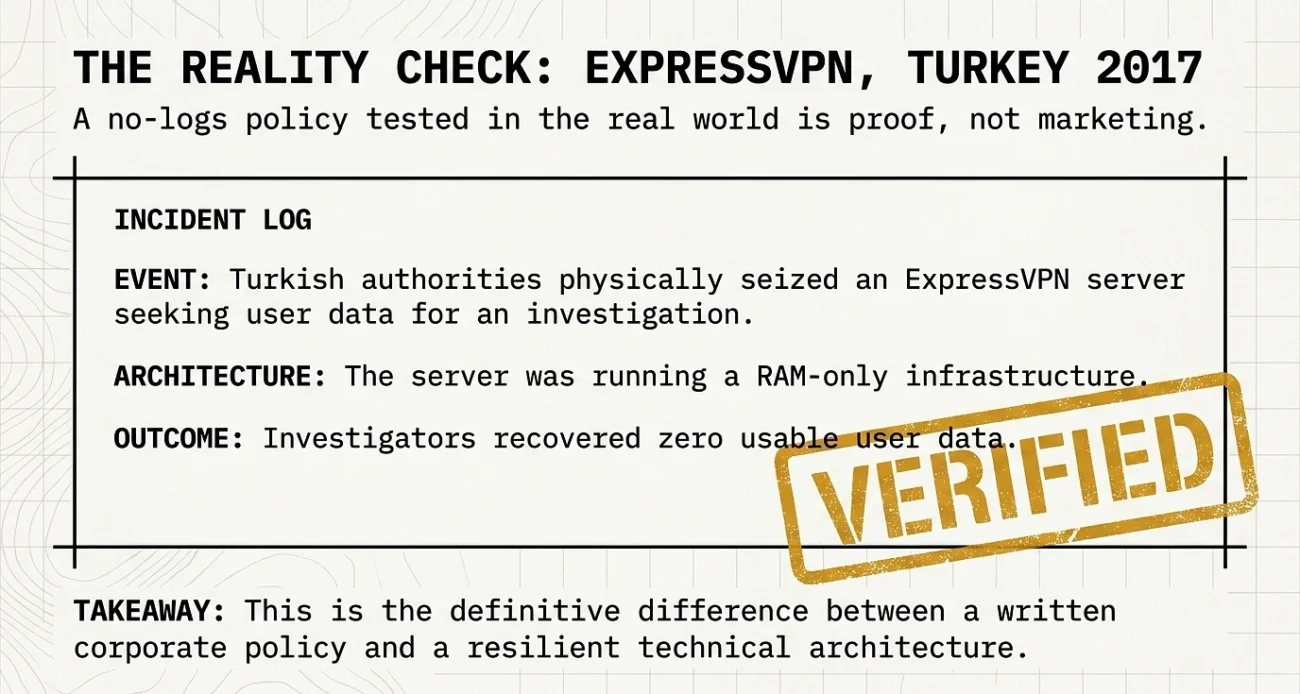
There’s a real-world test for this. When authorities seized an ExpressVPN server in Turkey back in 2017, they recovered no usable user data, because the server ran entirely in RAM with nothing stored. That’s the difference between a policy and an architecture.
Reading A No-Logs Claim Like A Skeptic
You don’t need a law degree to size up a provider. Hypackel, the checks we run before trusting any “no-logs” badge come down to four questions:
- Where is it based? A haven country is a green flag. A retention-mandate country is a reason to keep reading.
- Does it run RAM-only servers? If a seized machine can’t give up your data, the claim has teeth.
- Has it been independently audited? A named firm and a recent date beat a homepage promise.
- Has the claim ever been tested? A no-logs policy that survived a real server seizure or court order is proof, not marketing.
Hit all four and the promise is probably real. Miss two or three and the badge is just decoration.
Before You Trust The Toggle
A no-logs label is the easiest thing in the world to print on a website. Whether it means anything depends on a law you’ll never see in the app. For everyday privacy, any solid audited VPN based in a sane jurisdiction is plenty. If your threat model is more serious, the country on the company’s paperwork matters more than any feature in its brochure. Check the jurisdiction first, and let the marketing come second.