The Age Printed On Cooperative Board Games For 5 Year Olds Is Mostly A Guess

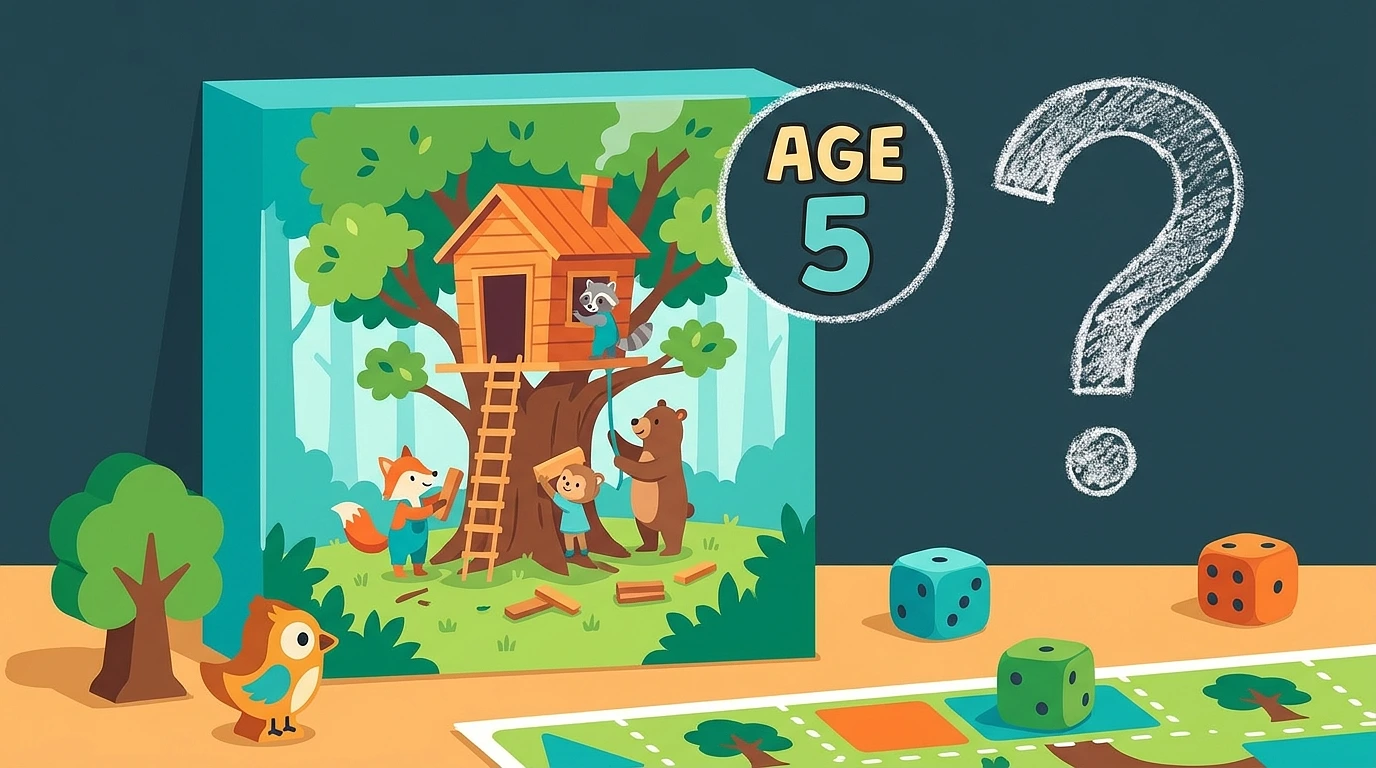
Gamewright puts five and up on the Outfoxed box. The Family Gamers played it with little kids and said it works great with exactly that group. The Smarter Learning Guide played the same game and came away thinking it does not really land until about seven. Those are three sets of people who have all sat down and actually played the thing, which is more than you can say for most of the lists you will find, and they cannot agree within two years of each other.
Which is roughly the whole problem. Five is a very wide age. A kid who turned five in March and has been playing games with an older sister since she was three is a completely different player from a kid who turned five last week and has never held a hand of cards, and the box gets one number for both of them.
So what follows is not ranked. I do not think a ranking survives that gap. What I have tried to do instead is say what each game actually asks a child to do, because that is the part you can hold up against your own kid and get a real answer out of.
Hoot Owl Hoot Lets You Change The Difficulty By Adding Owls
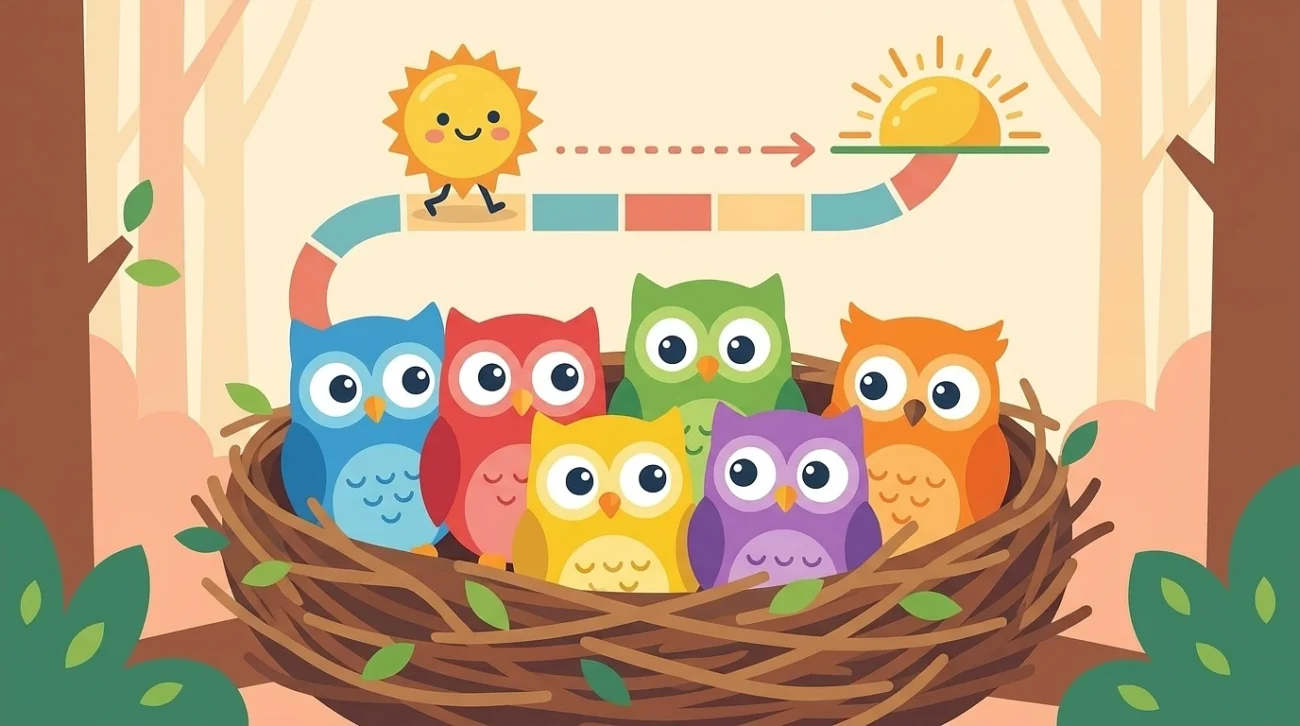
Six owls, a nest, and a sun that keeps rising. You play a color card and an owl flies to the next space of that color, and if you draw a sun card instead then dawn moves one step nearer and the owls are one step closer to being stuck outside when it comes up.
It is a simple game. Peaceable Kingdom have been selling it out of Berkeley since 2010, illustrated by Betsy Snyder, two to four players, about fifteen minutes. The only decision you ever make is which owl to move, and that decision repeats for the whole game.
But it has something almost none of the others bothered with, which is that you set the difficulty by choosing how many owls go on the board. Three owls and a four year old wins comfortably. Six owls and it gets tight, and you will lose some. That dial is why this game is still in the cupboard three years later while the flashier boxes have gone to the charity shop, and it is worth more than any age rating printed anywhere on the packaging.
There is also a rule that you say “hoot” every time you fly one owl over another one. Small thing. Does nothing mechanically. Kids do it every single time and keep doing it long after they have stopped needing the rest of the rules explained to them.
Somewhere Along The Way “Cooperative” Turned Into A Sales Word
Read the back of a Peaceable Kingdom box sometime. The one I have in front of me lists what cooperative games foster, and the list runs to non-stressful play situations, emotional development, shared decision making, creative problem solving, a sense of community, positive self esteem, playfulness, and cooperation. Eight things. On a fifteen minute game about owls.
I am not knocking the games, which are good games. But that copy is doing a job, and the job is making a parent in an aisle feel like the twenty dollars is an investment rather than a purchase, and once you have noticed it you start seeing it on every box in the section.
Mermaid Island Is Here For One Reason
Two to six players. Every other game in this piece stops at four.
Three mermaids are swimming home, a Sea Witch is chasing them, you spin a spinner and decide together which mermaid moves. The decisions are thin because the spinner does most of the work, and it won a Good Housekeeping toy award, which tells you roughly what kind of game it is.
If you have cousins over, though, or you are running a table at a birthday party, this is the one where a kid does not end up standing behind somebody’s chair watching. For a game whose entire pitch is that everybody gets included, that matters more than how deep the strategy goes.
Magic Maze Kids Will Not Let You Take Over Even If You Want To
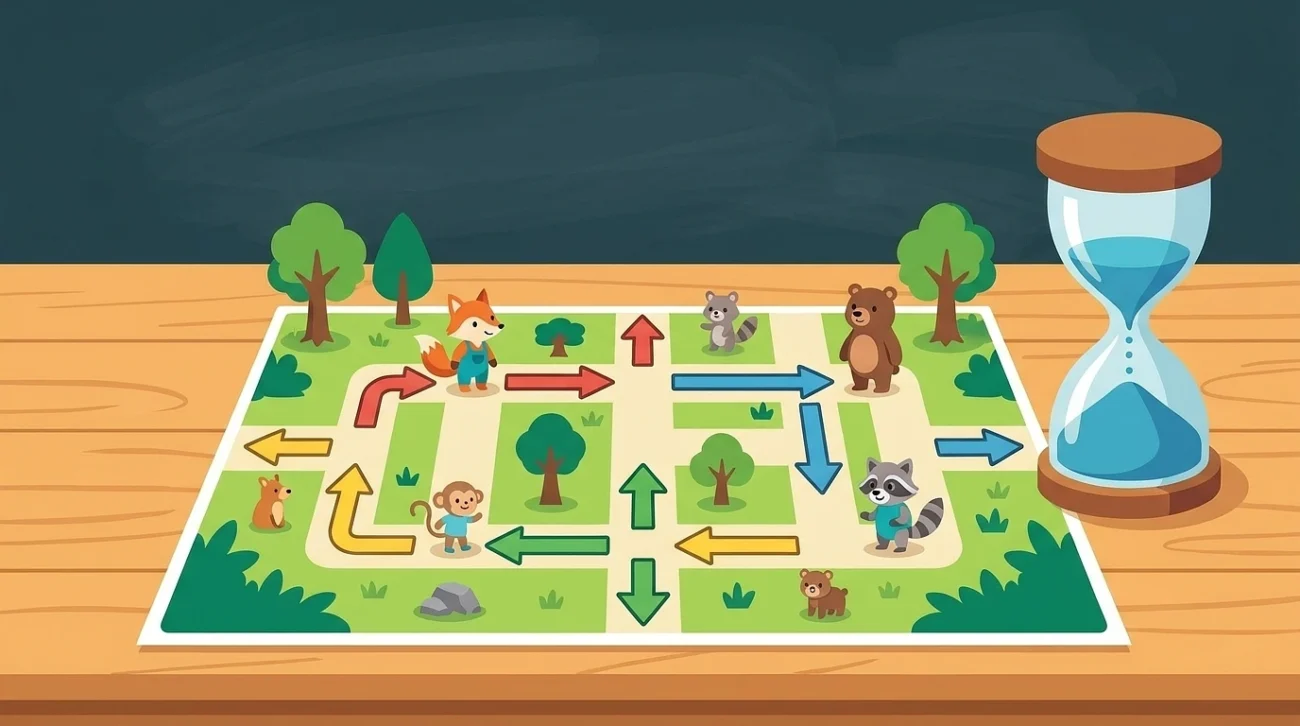
Kasper Lapp designed the original Magic Maze, the one where four adventurers rob a shopping mall and the players are not allowed to talk to each other, and it picked up a Spiel des Jahres nomination in 2017. Sit Down! published the children’s version the year after, and Lapp did something smarter than simply cutting bits out.
Everybody controls all the heroes. But each player can only move them in one direction. You get north, your kid gets east, somebody else gets south. So if the ingredient you need is sitting to the east and you can see exactly what has to happen, you cannot do it. You have to say it out loud and then sit there while a five year old thinks about whether they agree with you.
Which is either the best feature in any of these games or a slightly gimmicky constraint, and honestly I go back and forth on it. It does solve something real. Every parent who has played a cooperative game with a small child knows the moment where you quietly become the person deciding everything and your kid becomes a hand that moves pieces to the square you pointed at. Board gamers call this quarterbacking and argue about it endlessly, mostly in the context of adults doing it to other adults.
I am not sure it is the disaster people say it is when the two players are a parent and a five year old, though. Some help is the whole point at that age. A kid learning a game from a grown-up who talks the reasoning through out loud is getting something worth having. The problem only really becomes a problem when the talking stops and the pointing starts, and I have never seen anyone draw a clean line between the two.
What Magic Maze Kids does is draw the line for you, mechanically, whether you wanted it drawn or not.
Worth knowing before you buy it:
- Four boards, A through D, with the rules taught on the reverse of each one, so it grows across a couple of years rather than a couple of months
- Creatures sit in the maze blocking routes, which is not in the adult version at all
- Real time, with an oversized sand timer sized for small hands
- Two to four players, fifteen to twenty five minutes, and it made the Kinderspiel des Jahres recommendation list in 2019
That real time bit is the one to think hardest about. Some five year olds find a running timer thrilling. Some find it a lot, and freeze, and then the other players start making their moves for them, which is the exact thing the direction rule was built to stop.
Outfoxed Is Guess Who With A Fox In It
That comparison is not mine, The Family Gamers got there first, but it is exact and it explains both why the game is good and why the age fight at the top of this piece exists at all.
Mrs. Plumpert’s pot pie has gone missing. There are sixteen fox suspects. You roll, you move, you collect clues, and you slot each clue into a plastic evidence scanner that shows you whether the guilty fox is wearing a scarf or glasses or whatever it happens to be. Meanwhile the fox pawn is walking toward the exit, and if it gets there before you name the culprit then everybody has lost. Gamewright put it out in 2015, designed by the Department of Recreation studio, and it took the As d’Or children’s prize in 2018.
The scanner is a fantastic bit of design. Kids love the little window, they love being the one to open it, and that small physical hook does a lot of work in a game that is otherwise fairly dry.
Now think about how a five year old plays Guess Who. They ask a question, they get an answer, and then they forget which faces the answer ruled out and flip a few at random. Outfoxed wants that same elimination logic across sixteen suspects with several attributes live at once, and it wants them to hold it all while a timer walks toward them. Some five year olds do that. Plenty of them do not, and then the adult ends up holding the deduction in their head, which is a boring game for the adult and a fetch quest for the child.
The Reviewer Who Accidentally Taught His Daughter To Boss Him Around
Fireside Games took Castle Panic, their tower defense game, and stripped the reading out of it for preschoolers. Monsters march down a path toward your castle, every space on that path has a color and a shape, you hold cards with defenders on them who also have a color and a shape, and matching one to the other throws that monster in the dungeon. Justin De Witt designed it, one to four players, twenty minutes, four and up.
The bit I keep coming back to is from Board Game Quest’s review. The reviewer deliberately captured the wrong monster, the one that was not closest to the castle, to test whether his daughter had actually followed the strategy or was only matching shapes.
She had followed it. She told him no, we take the one nearest the castle, took the card out of his hand and did it herself.
He passed his own test and, in his words, accidentally taught his daughter to quarterback a cooperative game. I like that story because it refuses to resolve. She proved she could read the board well enough to correct an adult, which is what you were hoping for. She also worked out that when somebody makes a bad move you take their turn off them. Both things happened inside about thirty seconds and I am still not certain the second one is a problem, or that if it is, it is the game’s problem rather than a five year old’s perfectly reasonable read of the situation.
Race To The Treasure Asks For Planning, Which Is Rare Down Here
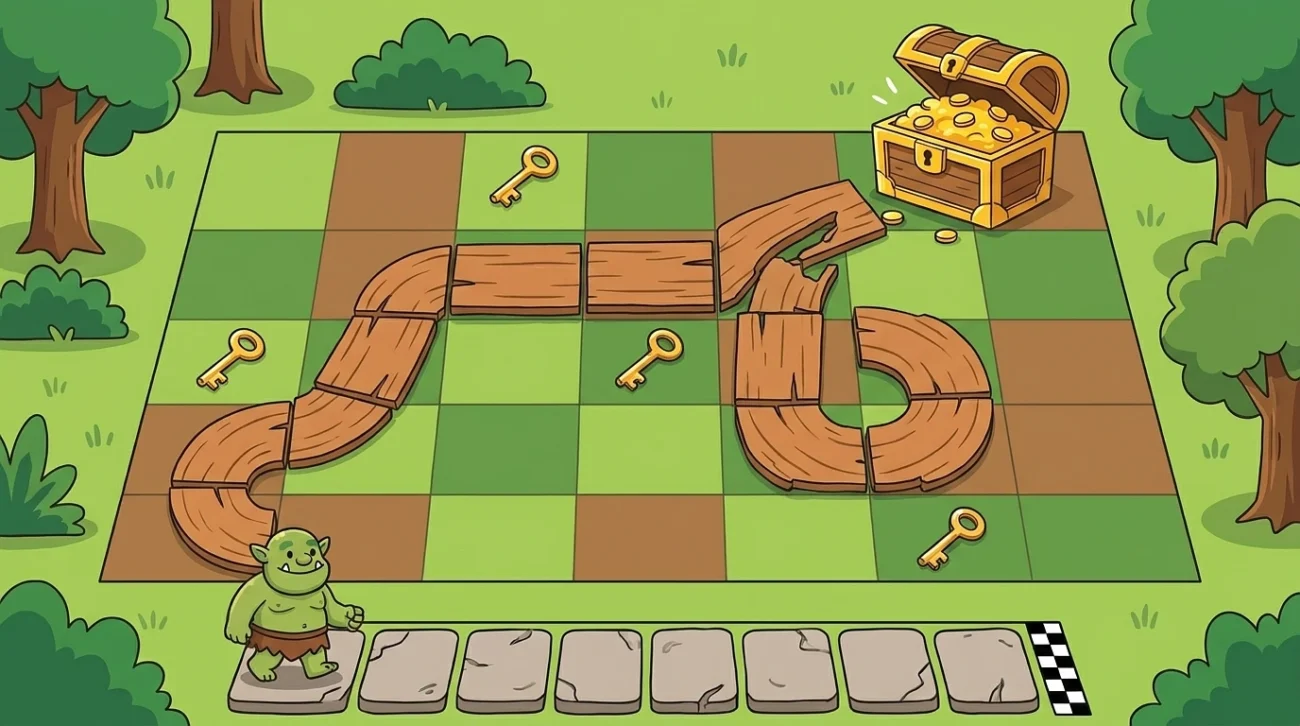
You are laying path tiles across a grid to get an ogre to a treasure chest, picking up three keys along the way, and the ogre keeps advancing whether your path is finished or not. Peaceable Kingdom again, five and up, two to four players, and it plays solo if you want it to.
The planning it wants is small, maybe one or two moves ahead. But it is real planning, and for a lot of kids this is the first game that has asked for any at all, which makes the losses land differently. When you lose Hoot Owl Hoot the sun came up and that was luck. When you lose Race to the Treasure you can look at the board afterwards and see the dead end you built, and a five year old can see it too, and that is either a good lesson or a rough evening depending on the kid and the hour.
No reading involved, by the way. It is all shape and grid recognition, so a pre-reader is not held back.
Dinosaur Escape Says Four And Up And Is The Hardest Game Here
Three dinosaurs are lost under twelve fern tokens, a volcano is going off, and every wrong roll adds another piece to a 3D volcano puzzle that ends the game once it is finished. You flip ferns hunting for matching dinosaurs and walk them toward the island.
The memory load in this is heavier than anything else in this article. You are holding which fern hid which dinosaur across the whole table, and the design assumes you are all saying that out loud to each other, which small children are not naturally good at. An adult with a decent memory will basically solve the game alone while the five year old flips ferns at random, and you will both call it teamwork on the way to bed.
The Study Everyone Quotes, And What It Probably Does Not Prove
There is a well known set of experiments out of the Max Planck Institute in Leipzig where researchers handed young children a block stacking game and quietly built in the option to steal blocks off a rival’s tower. Any adult sees the move instantly. Take their blocks, every turn, obviously. Marco Schmidt and his colleagues found that even the five year olds barely did it, no more often than you would expect from chance, and in related work children did not hit back even after somebody had done it to them first.
This gets quoted constantly as proof that little kids are not wired for competitive play and ought to be handed cooperative games instead. It might mean that. It might also mean that a five year old sitting in a lab with a friendly researcher does not want to be the sort of person who wrecks somebody’s tower, which is a different finding entirely, and the researchers were more careful about the distinction than the blog posts citing them tend to be.
I would not buy a cooperative game because a study told me to. I would buy one because the alternative at this age is Candy Land, where the child makes no decisions of any kind and the winner was decided when the deck was shuffled.
Two Things People Will Tell You To Buy Too Early
Gnomes at Night is six and up and it is excellent, and it is also a game where two players move a shared piece through a maze they each only half see, which asks for spoken spatial description that most five year olds simply do not have yet. Zombie Kidz Evolution is seven and up and it is a legacy game, meaning it changes permanently as you play it, and there is no version of that which is a good idea for a household still learning what taking turns means.
Both of them are worth buying. Buy them in a year.
One Last Thing About That Number On The Box
Pull out the Hoot Owl Hoot rules sheet and look at the bottom of it. There are two ages printed there. One says the game is for four and up. The other is a choking hazard warning saying not for children under three.
Only one of those numbers is a regulated safety standard that somebody had to test for and can be held to. The other is a judgment call made by a company that would quite like as many people as possible to feel the box on the shelf is for them.