
Continuous Localization for Live-Service Games: Why One Patch Can Break Three Languages

I spent a fortnight buried in localization documentation, engine forums and LQA bug dictionaries for this piece, and the thing that surprised me most was how rarely the horror stories were about translation at all.
I am Sky Ariella. I write for a living, which means I research for a living, and this particular rabbit hole turned out to be deeper than expected. Almost every expensive failure I found traced back to a decision made by an engineer, months before anyone thought about shipping in Polish.
Here is the clearest example of what I mean. Somewhere in most codebases, there is a line like this:
"You killed " + enemyName + " with " + weaponNamePerfectly reasonable. Works in English. Then the game sells in Japan, where the verb belongs at the end of the sentence rather than the middle. And in Germany, where the article in front of a weapon name shifts depending on that noun's gender, which the code cannot supply. And in Russia, which wants one plural form for numbers ending in 1, a second for 2 through 4, and a third for everything else, none of which three glued-together text chunks can produce.
A translator will spot it in seconds and be entirely unable to fix it.
Live-Service Removed The One Thing That Made This Manageable
A single-player release gives you a freeze. Content lock, strings out, translations back, certification, done. Unpleasant, but finite.
Live games took that away. At any moment you have a seasonal event in staging, a balance patch in QA, three store bundles being written by someone in marketing who does not know the loc pipeline exists, and support macros nobody mentioned to anyone. All of it player-facing, all on separate schedules. A single major update on a large live title can run into hundreds of thousands of words.
The Engineering, Because That Is Where It Is Won Or Lost
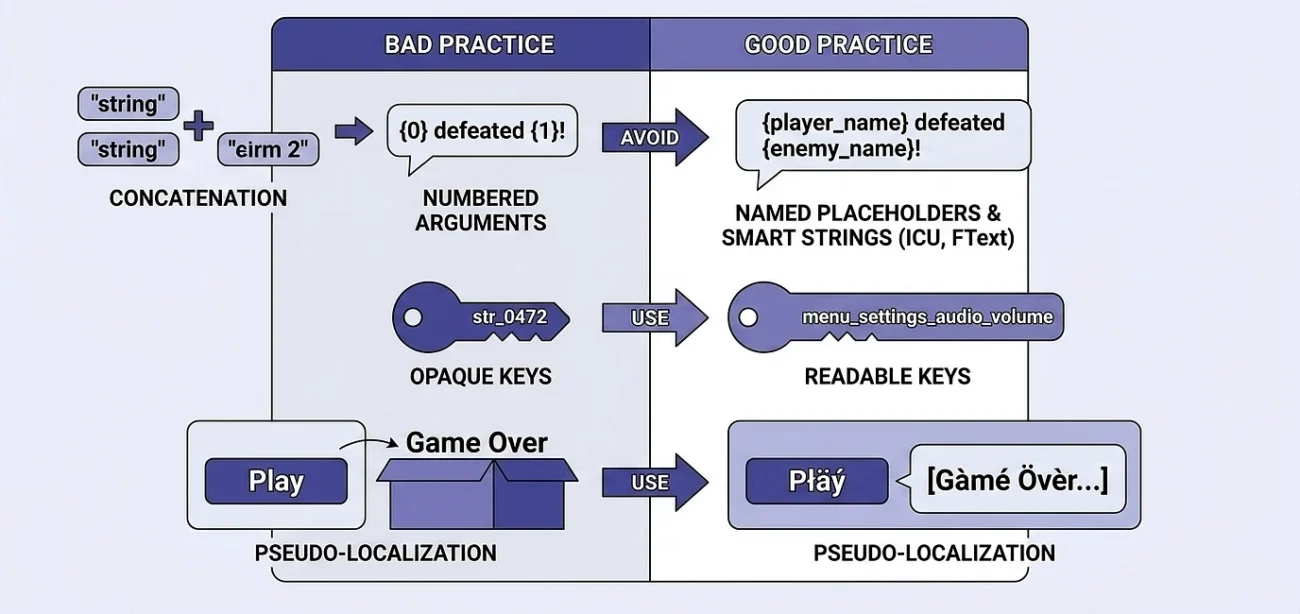
- Stop concatenating. Use formatting with named placeholders. ICU Message Format exists precisely because plurals and gender agreement are difficult and somebody already solved the problem properly. Unity’s Localization package offers Smart Strings for this. Unreal handles it through
FText, and if player-facing text is travelling around a project asFString, that is worth raising this week rather than discovering in year two. - Named arguments rather than numbered ones.
{0}and{1}will not hold their order once a German translator rebuilds the sentence. When they swap, the resulting bug exists in one language and nowhere else, which takes days to find because nobody on the team reads the language it is broken in. - Write string keys somebody can read.
menu_settings_audio_master_volumehands a translator context for free.str_0472hands them a guess. - Run pseudo-localization constantly. Replace every string with an accented version padded to roughly 140%, then play the build. Anything still in plain English was hardcoded and never extracted. Anything overflowing its container will overflow in German. It takes a day to set up and catches problems a player in Lisbon would otherwise find three weeks after launch.
Of everything I read, that last one had the best return for the least effort, and it is the piece small teams skip most often.
Terminology Drift, And Why Final Fantasy Is The Cautionary Tale
This is the failure players actually notice, and it is not about translation quality at all.
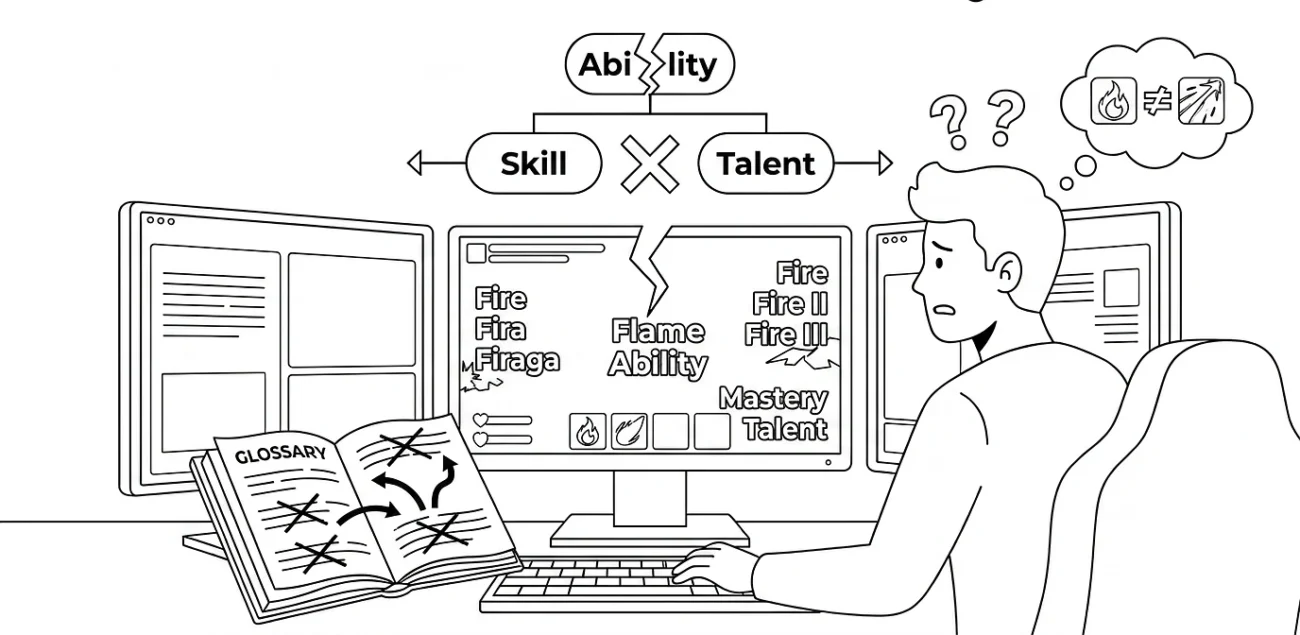
You rename an ability in a balance patch. The English tooltip updates. The localized tooltip does not, because nothing flagged it as changed. Support macros still carry the launch-era name. The store bundle selling that ability uses a fourth variant, translated fresh by someone who never saw the glossary.
Every string is correct. Every string passed review. And the player concludes nobody at the studio is paying attention.
The best documented case of this is Final Fantasy, which is not a small indie operation. Because a different translation team handled nearly every entry, terminology diverged across the series. Writers at Legends of Localization point out that the franchise never actually settled how to treat the -ra and -aga spell suffixes. The approach mostly stabilised around Final Fantasy VIII, then changed again to II and III in Final Fantasy XIV. Long-time players had to relearn naming logic that should have been constant.
The industry version of this problem is smaller but constant. Localization QA specialists treat terminology and style inconsistency as its own bug category, because the same concept translated two different ways makes a game feel disjointed even when both translations are technically right.
There is a subtler trap underneath it. Words that look interchangeable in English frequently are not. Skill, ability, talent and mastery can all exist in one game meaning four different systems, and a translator without a term base will flatten them into one or two words in the target language, quietly destroying a distinction the design team spent months building.
Fixing this is systems work:
- A glossary with a named owner. A person, not a shared sheet. Sheets rot.
- Change tracking on source strings, so an English rename raises a flag everywhere that term appears.
- Translation memory doing the reuse, rather than someone recalling what was approved last time.
- Hotfixes routed through the same pipeline as everything else. This is the one everybody breaks, and it is how a single sword ends up with three names.
The first one sorts the field quickly game localization expert will answer without hesitating, and providers running game translation services for ongoing titles should already have glossary enforcement worked out, since that is exactly where one-off translation shops come apart.
Context Is The Other Half Of It
The famous failures nearly all come down to translators working without context.
Modern Warfare 2 gave the world one of the worst examples. The line “Remember, no Russians” reached Japanese players as something closer to an instruction to kill them, because the translator had a spreadsheet and no scene. Older readers will remember the Zelda character who introduces himself with “I am Error”, which was a deliberate joke in Japanese that did not survive the trip.
Neither of those is a competence problem. Hand anyone a list of isolated strings and ask what “Fire” means, and they cannot tell you whether it is a button, a damage type or a noun.
This is also why genre knowledge matters as much as fluency. Give “rogue” to an excellent linguist with no RPG background and the dictionary answer comes back, which has nothing to do with what players mean. Same for tank, farm, proc, meta, gank and a couple of hundred other terms communities use without thinking.
Tooling, Briefly
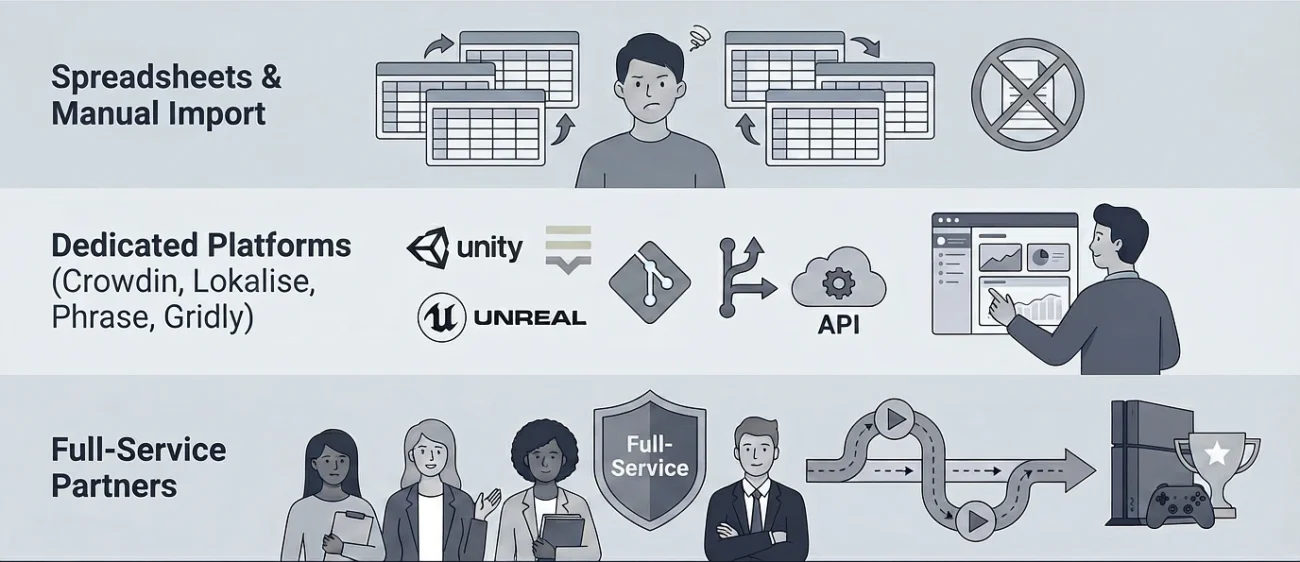
Three tiers, and the right one depends on volume and team size.
Spreadsheets with manual import work for a while. The ceiling appears the first time two people edit the same file simultaneously.
Dedicated platforms, Crowdin, Lokalise, Phrase, Gridly among others, provide branching, version control, translation memory and APIs so the build pulls strings itself. Most integrate directly with Unity and Unreal, which removes the manual reintegration step where a lot of loc bugs are born.
Full-service partners bundle linguists with the workflow, which usually beats appointing an accidental localization producer in week six of a season.
The requirement underneath all three is the same. Nobody copies strings by hand.
Testing Belongs In The Running Game
A string approved inside a translation tool was approved blind. Nobody saw it rendered on a button, or knew a runtime variable would add fifteen characters to it.
So LQA runs in the build, with native speakers who play games, scoped to what changed rather than full regression. On a live title there is no time for anything else and everyone involved knows it.
Length differences are predictable enough to plan for, incidentally. German and Russian commonly run 30% or more past English, Finnish can be worse, and CJK usually comes in shorter but breaks lines on rules most layouts are not expecting. Arabic and Hebrew are a larger commitment because the interface mirrors, not just the text.