
Are AI-Powered Games Demanding More from Your Graphics Card?


Key Points:
Yes but the way they’re demanding more has changed. Modern games aren’t just asking your GPU to push more pixels. They’re asking it to run small neural networks in real time, alongside everything else it already does.
Here’s what that actually means in practice:
- You need dedicated AI hardware now. Tensor Cores on NVIDIA cards and the equivalent AI accelerators on AMD’s RX 7000 and 9000 series do the heavy lifting for upscaling and frame generation. A GPU without them can still play games, but it’s playing them the hard way.
- VRAM is the new bottleneck and it’s expensive. AI data centers have eaten most of the world’s high-bandwidth memory supply. GDDR7 spot prices rose roughly 40% between late 2025 and early 2026, and that cost is landing on consumer cards. The RTX 5090 launched at $1,999 and is currently changing hands for $3,500 to $4,000.
- AI also gives back. DLSS 4.5 and FSR let your GPU render at a lower internal resolution, then reconstruct the image at 1440p or 4K. On RTX 50-series cards, the newest Multi Frame Generation produces five AI frames for every one rendered frame a 6x multiplier that turns 40 fps into 240 fps in supported titles.
- 32GB of system RAM is the new comfortable minimum. Game engines that lean on AI for NPC behavior, physics, or scene streaming push memory usage past what 16GB handles cleanly.
A few years ago, asking whether a game was "demanding" mostly meant asking how many pixels it needed to push and how much geometry was on screen. That question is still relevant, but it isn't the whole question anymore. The interesting thing happening inside modern game engines is that part of the rendering pipeline has been quietly handed off to neural networks. Your GPU isn't only drawing the frame it's predicting parts of it.What’s Actually Running on Your Card Now

When you boot up a recent path-traced title Cyberpunk 2077, Alan Wake 2, the upcoming 007 First Light there are five or six AI models executing per frame. Super Resolution upscales the image. Ray Reconstruction replaces hand-tuned denoisers for ray-traced lighting. Frame Generation produces the extra frames between the ones your GPU actually rendered. Each one runs in a few milliseconds, on dedicated silicon, while the rest of the GPU handles shaders, geometry, and texture work.
NVIDIA’s 5th-generation Tensor Cores on the RTX 50 series exist specifically to handle this load. The 6X Multi Frame Generation mode in DLSS 4.5 released March 31, 2026 is only possible because the hardware can execute those AI models fast enough to keep up with 240Hz displays without becoming a bottleneck itself. On older cards without that horsepower, you simply don’t get the option.
This is the part of the conversation that confuses people. AI is making games more demanding in the sense that it adds workloads the GPU didn’t have before. But it’s also making games less demanding to render at high resolutions, because upscaling and frame generation let lower-tier hardware punch above its weight. Both things are true at the same time.
Q: Do I Really Need A Tensor Core GPU To Play Modern Games?
Not strictly. Plenty of games still run fine on cards without dedicated AI hardware. You’ll just be playing at native resolution with no frame generation safety net, and once ray tracing enters the picture, performance falls off a cliff. The honest answer is that competitive 1440p and 4K gaming in 2026 effectively assumes you have AI acceleration available. If you don’t, you’re either dropping settings, dropping resolution, or accepting frame rates that won’t feel right on a high-refresh monitor.
The Price Problem Nobody Saw Coming
For most of the last two years, the bottleneck stopped being raw chip manufacturing and became memory. AI data centers Microsoft, Google, Meta, Amazon have been buying high-bandwidth memory faster than Samsung and SK Hynix can produce it. The same fabs that make GDDR7 for your gaming pc card also make HBM3e for AI accelerators, and the AI accelerators sell at margins that make consumer graphics look like a hobby.
The result is unusual: VRAM now accounts for more than 80% of a GPU’s total bill of materials. That’s a complete inversion of how the cost structure used to look. The 16GB of GDDR7 on a midrange card reportedly went from costing around $65–$80 in mid-2025 to over $200 by the end of that year. Card makers can’t absorb that, so the prices on the shelf have moved.
GPU Pricing Reality Check (May 2026)
| Card | Launch MSRP | Current Street Price | Notes |
|---|---|---|---|
| RTX 5090 (32GB GDDR7) | $1,999 | $3,500–$4,000+ | Flagship; some forecasts see $5,000 by mid-year |
| RTX 5080 (16GB GDDR7) | $999 | $1,200–$1,500 | Sporadic MSRP availability |
| RTX 5070 Ti (16GB) | $749 | $1,000+ | “Bad when the 5070 Ti is over $1,000” — common refrain |
| RTX 5070 (12GB) | $549 | $599–$700 | Occasional MSRP sightings |
| Radeon RX 9070 XT | $599 | $700–$850 | Closest AMD competitor to RTX 5070 Ti |
| Intel Arc B580 (12GB) | $249 | $250–$300 | Uses GDDR6, less affected by shortage |
The Intel cards are an interesting footnote. Because they use older GDDR6 instead of GDDR7, they’ve largely sidestepped the worst of the price spike. That doesn’t make them flagship competitors, but for someone building a budget AI-capable system, they’re suddenly a reasonable conversation.
Q: Should I Wait For Prices To Come Down Before Upgrading?
Probably not, and that hurts to say. Memory analysts at Micron have warned the shortage may extend into late 2027 or 2028. NVIDIA reportedly chose not to announce new consumer GPUs at CES 2026, which is the first time in roughly three decades they’ve skipped a generation announcement. If you need a card now and you find one near MSRP, that’s the upgrade window. Waiting for a 2024-style market correction is waiting for something that may not arrive.
What AI Gives Back
The genuinely good news is that AI rendering is the most efficient performance multiplier the industry has ever shipped. DLSS Performance mode renders games at roughly a quarter of your target resolution and reconstructs the rest. With the second-generation transformer model in DLSS 4.5, Performance mode is now visually comparable to native rendering =in some scenes it actually beats native, because the AI model handles temporal stability and edge antialiasing better than traditional techniques.
Layer Multi Frame Generation on top, and the math gets strange. A scene rendering at 40 fps natively can display at 240 fps with 6X frame generation enabled, and the perceived latency stays acceptable because NVIDIA Reflex handles the input timing separately from the displayed frames. It isn’t magic there’s a small responsiveness tradeoff =but in single-player and slower competitive titles, the difference is hard to notice in practice.
AMD’s FSR has been catching up. It’s still behind DLSS on image quality in most direct comparisons, but the gap is narrower than it used to be, and FSR works on a wider range of hardware including older NVIDIA cards. For someone on an RTX 30 series or GTX 1660, FSR is often the more practical option.
Q: Is 8GB Of VRAM Enough For Gaming In 2026?
Honestly, not really not at 1440p with modern AAA titles. 8GB cards run into texture streaming issues, frame time spikes, and outright crashes in games like Indiana Jones and the Great Circle or Star Wars Outlaws on higher settings. 12GB is the realistic floor for new purchases. 16GB is the sweet spot for 1440p with ray tracing and frame generation enabled. For 4K and future-proofing into the next generation of AI-heavy engines, 16GB to 24GB makes more sense.
Q: Does AI In Games Affect Anything Besides Graphics?
Yes, and this is the part that gets less coverage. NVIDIA ACE is bringing real-time AI dialogue and behavior generation to games like PUBG: Battlegrounds, where an AI teammate develops long-term memory and adapts to your playstyle. Total War: PHARAOH demoed an AI assistant that helps players navigate complex strategic systems. These features run on the same Tensor Cores that handle rendering AI, which is part of why dedicated AI hardware is becoming table stakes rather than a flagship-only luxury. Expect more NPC AI, more dynamic difficulty, more procedural content generated on the fly all of it consuming GPU resources alongside the rendering pipeline.
Q: What About System RAM?
This is the upgrade most people skip and regret. 16GB is now a bottleneck for AI-heavy games and modern Windows builds running alongside browsers, Discord, and game launchers. 32GB is the comfortable answer. DDR5 prices have been rising for the same memory-shortage reasons GPU prices have, but 32GB kits are still reasonably priced compared to bumping up a GPU tier. If you’re spending $700+ on a graphics card and pairing it with 16GB of system memory, the imbalance is going to hurt.
Future-Proofing Without Guessing
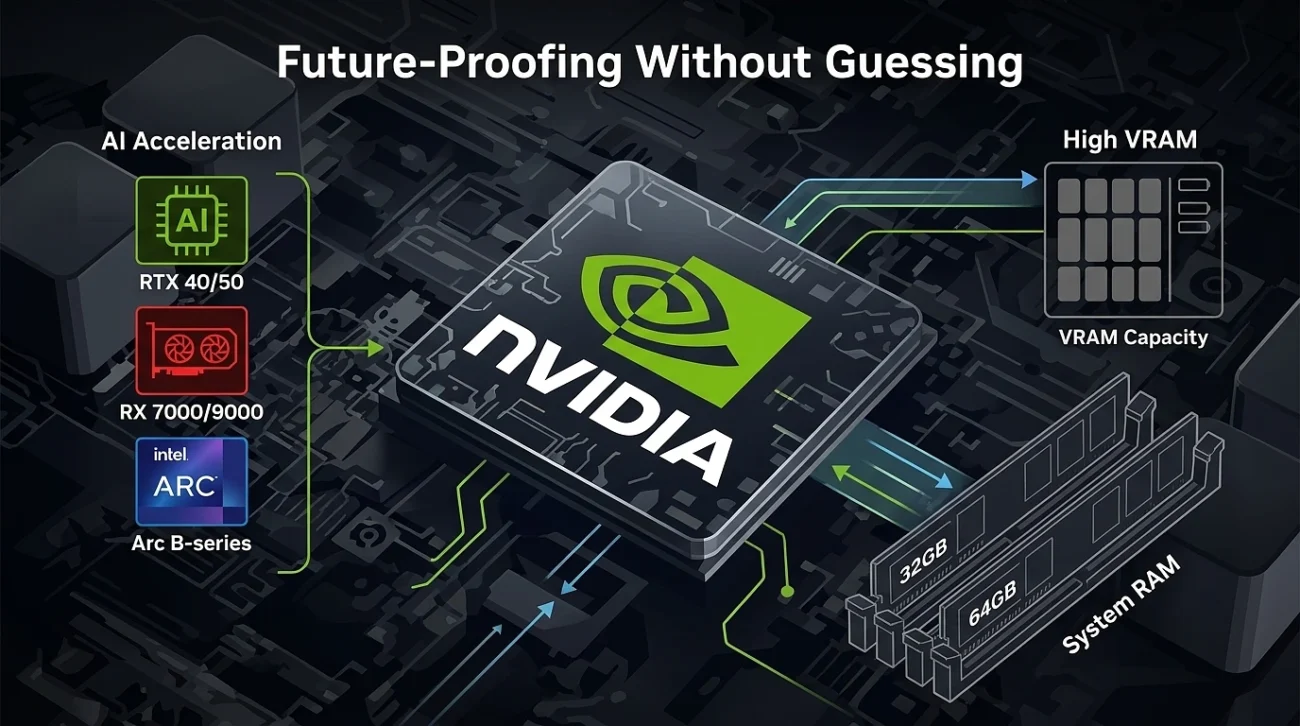
If you’re building or upgrading right now, the priorities have shifted in a way that’s worth thinking through carefully. Raw shader performance still matters, but it isn’t the deciding factor it used to be. The questions that actually predict how long a system stays useful are different.
The first is whether the GPU has modern AI acceleration meaning RTX 40-series or 50-series for NVIDIA, RX 7000 or 9000 for AMD, or Intel Arc B-series. The second is how much VRAM the card carries, because that determines what resolutions and settings remain accessible as game engines lean harder on high-resolution textures and AI inference. The third is system memory, where 32GB is the new floor for serious gaming rigs and 64GB is increasingly reasonable for anyone doing creator work alongside gaming.The cards themselves matter less than they used to in some ways and more than they used to in others. A GPU with weaker shaders but strong Tensor Cores can outperform a stronger traditional GPU in any title with DLSS or FSR support, which is now most titles worth playing. The architecture genuinely matters.
Q: Should I Buy Used Gpus To Save Money?
The used market is more rational than the new market right now. Used RTX 3090s are actually cheaper than they were a year ago because owners are upgrading to Blackwell, and a 3090 with 24GB of VRAM is still a capable 1440p card with full DLSS support. Used RTX 4070 and 4070 Ti cards are also decent value if you find clean ones. The risks are the usual: no warranty, potential mining wear, and you’re locked out of the newest DLSS features that need 50-series hardware. For most buyers in 2026, a clean used 40-series is the rational compromise between price and capability.